Auto-retry failed payments
When a payment fails, Storeganise can automatically retry the charge on the customer's registered payment method, on a schedule you control. This helps recover revenue without admins or customers retrying each failed payment by hand.Auto-retry works with all supported payment gateways, including Stripe, Mollie, and Fortis.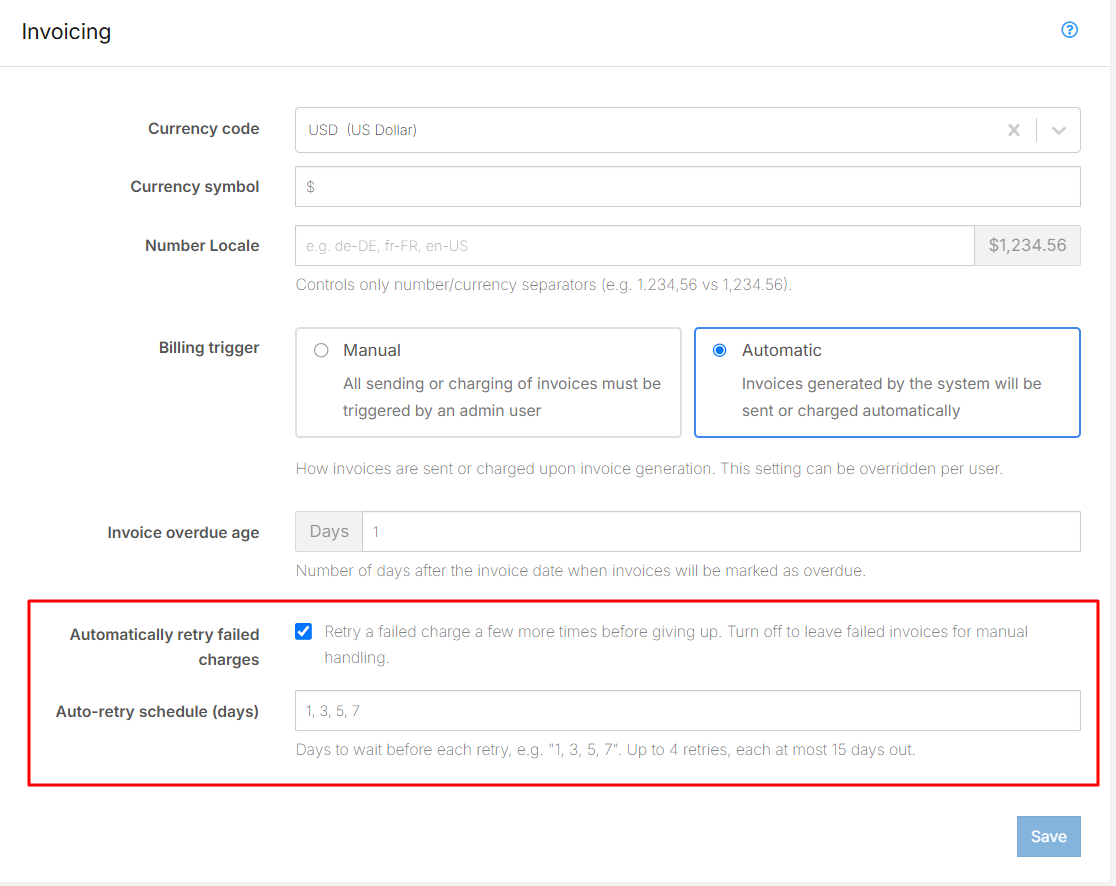
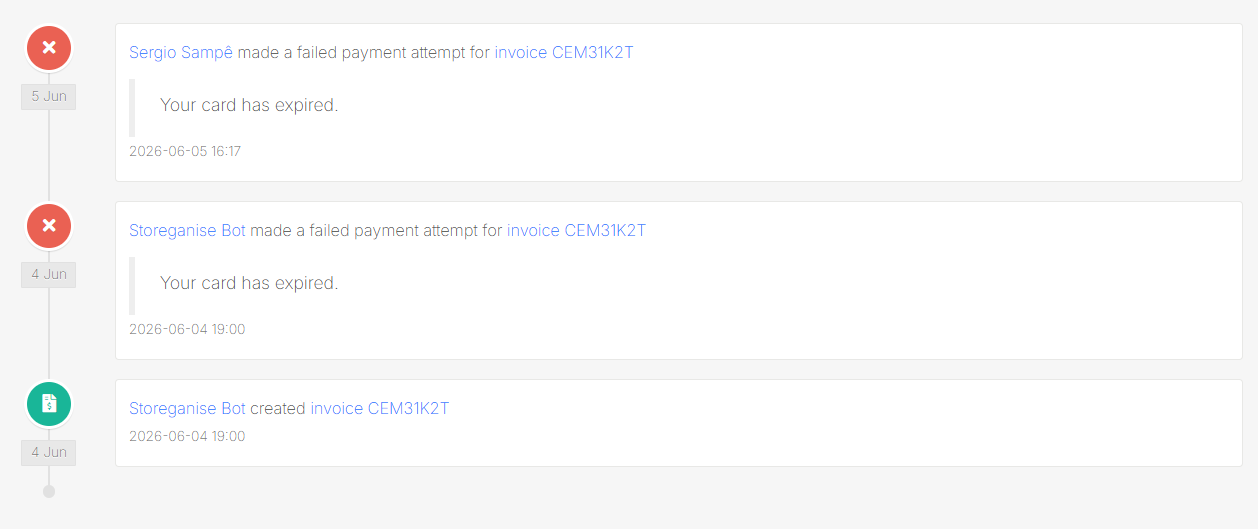

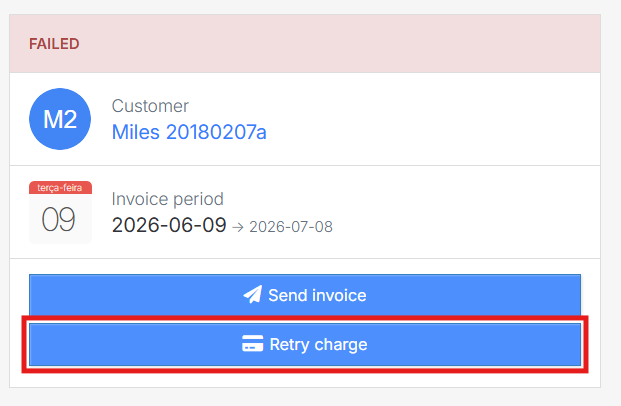 The system immediately attempts a single charge on the customer’s registered payment method. If the charge succeeds, the invoice is marked as Paid and a receipt email is sent. If it fails, the customer receives the failed invoice email.A manual retry doesn’t restart or move the schedule. Any remaining automatic retries still run on their original dates.
 Once cancelled, the system stops all future automatic retries for that invoice. You can still manually charge the customer using the Charge customer button at any time.
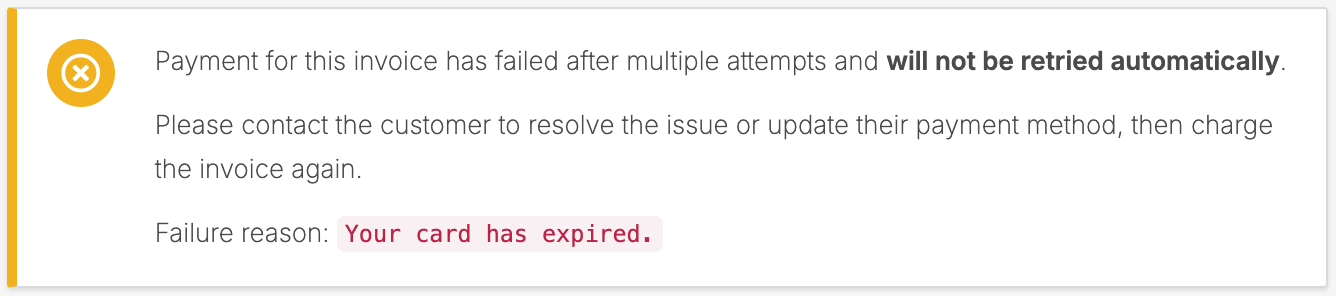 No further automatic retries are scheduled after the last one, even if you manually retry the charge. At this point, you can:
Do I need to enable auto retry? No. Auto-retry is on by default. You can change the schedule or turn it off in Main settings > Invoicing.Does auto retry work with all payment gateways? Yes. Auto-retry works with all supported payment gateways, including Stripe, Mollie, and Fortis.Can I customize the retry schedule? Yes. Go to Main settings > Invoicing to set up to four retries, each up to 15 days after the original charge attempt. The default is 1, 3, 5, and 7 days.Does the customer receive an email for every retry attempt? No. The failed invoice email is only sent for the first failed charge and for manual retries, not for automated retries.What happens if the customer updates their payment method during the retry cycle? The next scheduled retry uses the customer's current registered payment method. If the customer updates their card or bank details, the next retry automatically uses the new details.Can I still manually charge a customer while retries are scheduled? Yes. You can use the Retry button on the invoice to trigger an immediate charge attempt, or use the existing Charge customer button at any time.Does auto retry affect the invoice state? No. The invoice stays in the Failed state throughout the retry process. It only changes to Paid if a retry or manual charge succeeds.
How auto-retry works
Storeganise retries a failed charge on set days after the original charge attempt. By default, it retries 1, 3, 5, and 7 days after the original attempt.Because each retry counts from the original attempt, not from the previous retry, the retry dates stay fixed. If a charge is still pending on one of those dates, that retry is skipped instead of running late.Changing the retry schedule
You can set how many retries run and when, or turn auto-retry off.- Go to Main settings > Invoicing.
- In the auto-retry settings, enter the days after the original charge attempt when each retry should run. Enter the day values separated by a comma and space, for example:
1, 3, 5, 7 - Click Save.
What happens during the retry process
While retries are in progress, the invoice remains in the Failed state. The system tracks the number of charge attempts on the invoice. Each retry attempt follows the same process as the original charge, using the customer's registered payment method.Notifications during retries
The failed invoice email is sent when the first charge attempt fails and when you manually recharge an invoice. It isn’t sent for automated retries, so customers who already get reminder, late fee, or delinquency emails don’t receive an extra email for every attempt.If a retry attempt succeeds, the invoice is marked as Paid and the customer receives a receipt email as usual.Invoice history
Every retry attempt and its outcome are logged in the History section at the bottom of the invoice detail page. You can see the timestamp and whether the charge succeeded or failed.Managing retries
You can monitor and control the retry process directly from the invoice detail page.Viewing retry status
Open a failed invoice to see the current retry status. The alert banner at the top of the page shows:- The attempt number
- The error returned by the payment provider
- The date of the next scheduled retry
Manually retrying a charge
If you do not want to wait for the next scheduled retry, you can trigger a retry manually:- Open the failed invoice.
- Click the Retry charge button in the alert banner.
Cancelling retries
If you want to stop the system from retrying a specific invoice (for example, if you plan to handle it manually or write it off), you can cancel the scheduled retries:- Open the failed invoice.
- Click the Cancel retries button in the alert banner.
What happens when all retries fail
If all scheduled retry fails, the system:- Marks the retry process as complete. The invoice remains in the Failed state.
- Updates the alert banner on the invoice detail page to reflect that all retry attempts have been exhausted.
- Manually retry using the Charge customer button if the customer has updated their payment method.
- Contact the customer to resolve the payment issue.
- Follow the bad debt invoice process if the payment can’t be recovered.
Frequently asked questions
Jump to
Related articles
Invoicing settings
Invoice states and outstanding balance
Billing / invoice related emails
Bad debt invoice process